 Saturday, November 12, 2005
After my off-hand comment yesterday about the KnoxNews home page layout, I ran into these two linked pieces today:
And I wish its front page design allowed an editor to summarize the top stories instead of mechanically stacking up headline links. For all I know, the process really is automated. The front page design allows only one line from the newspaper's two-line headlines... usually the shortest line of the two... and it rarely tells enough to make me want to follow the link to the full story.
Would you click on these?
A few decently-paid, well-caffeinated, living, breathing editors could fix those glitches in a hurry. And the robotic (or robot?) editor problem isn't just at KnoxNews:
Check out this CBS story on the "Googlebombing" connection between President Bush and the word "failure." If someone at WCBS hasn't fixed the page by the time you read this, you'll see "president" misspelled in one place; worse, there's also an unfortunate misspelling of the Google phrase "I'm Feeling Lucky," leaving out the "k." At this writing, the story has been like that for almost 48 hours. Don't they read this stuff?
Someone owes Lucy an apology.
2:38:16 PM #
- One of MediaCenter's Morph bloggers thinks KnoxNews is innovative, if short on content.
- Web news design veteran Jay Small, who I didn't realize was here working for Scripps these days, has a very informative essay that explains a lot: "Why news site designs aren't innovative."
And I wish its front page design allowed an editor to summarize the top stories instead of mechanically stacking up headline links. For all I know, the process really is automated. The front page design allows only one line from the newspaper's two-line headlines... usually the shortest line of the two... and it rarely tells enough to make me want to follow the link to the full story.
Would you click on these?
- Reunion on horizon
- Ky. man brings experience to Jacksboro
- A safe home for those in need
- Supermarkets
- More than one way to win
- Leave the heavy work to them
A few decently-paid, well-caffeinated, living, breathing editors could fix those glitches in a hurry. And the robotic (or robot?) editor problem isn't just at KnoxNews:
Check out this CBS story on the "Googlebombing" connection between President Bush and the word "failure." If someone at WCBS hasn't fixed the page by the time you read this, you'll see "president" misspelled in one place; worse, there's also an unfortunate misspelling of the Google phrase "I'm Feeling Lucky," leaving out the "k." At this writing, the story has been like that for almost 48 hours. Don't they read this stuff?
Someone owes Lucy an apology.
2:38:16 PM #
I'm not the only one telling students this is a great time to be
learning about journalism. As we enter the home stretch for this
semester's courses, it's good to see an essay in Online Journalism Review
arguing that journalism newcomers face the biggest opportunity to
redefine the news business in the 50 years since TV arrived.
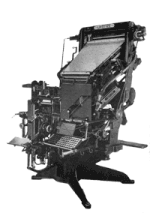 Maybe it's the best time in a full century -- since the "stop the presses" arrival of speedy Linotype machines, and since the Hearst vs. Pulitzer Yellow Kid circulation war gave us the term "yellow journalism." Maybe our new grads will even find a new color scheme.
A hundred years ago "the mass media" consisted of newspapers, newspapers, some magazines, and more newspapers. That's when Chicago editorial page icon "Mr. Dooley" could tell his saloon customers, "th' newspaper does ivrything for us..." Of course he meant "the newspapers," not just one of them. In his day, Chicago had 30 dailies!
That number comes from a 1908 media directory, which I just saw by following a link to the Library of Congress, courtesy of former Miami Herald webguy (and now Northwestern University prof) Rich Gordon.
Back to professor Gordon... (This is what we call a "buried lead.") His Online Journalism Review article, Online opportunities make journalism's future bright, despite gloomy feelings, is the one that inspired the notes you're reading now, historical digressions and all. Here's a sample from his piece:
1:18:22 PM #
Maybe it's the best time in a full century -- since the "stop the presses" arrival of speedy Linotype machines, and since the Hearst vs. Pulitzer Yellow Kid circulation war gave us the term "yellow journalism." Maybe our new grads will even find a new color scheme. A hundred years ago "the mass media" consisted of newspapers, newspapers, some magazines, and more newspapers. That's when Chicago editorial page icon "Mr. Dooley" could tell his saloon customers, "th' newspaper does ivrything for us..." Of course he meant "the newspapers," not just one of them. In his day, Chicago had 30 dailies!
That number comes from a 1908 media directory, which I just saw by following a link to the Library of Congress, courtesy of former Miami Herald webguy (and now Northwestern University prof) Rich Gordon.
Local note: The 1908 directory lists a dozen periodicals here in Knoxville, including two dailies -- the Republican Journal and Tribune and the Democratic Sentinel. The politics listed for each paper may have been balanced by the Sunday Independent. Other weeklies included the Saturday Review, whose affilation is listed as "Colored," a Thursday Methodist Advocate-Journal, and more. That's not quite a Rocky Top Brigade of diverse voices, but it's more newsprint than we have in circulation now.

Back to professor Gordon... (This is what we call a "buried lead.") His Online Journalism Review article, Online opportunities make journalism's future bright, despite gloomy feelings, is the one that inspired the notes you're reading now, historical digressions and all. Here's a sample from his piece:
"I think that when we look back on the early years of the 21st
century, we will recognize it as a period of exploding opportunity for
journalists and the start of an exciting new era for journalism. I also
think it's quite possible that we'll look back on these years as a
period when a better informed public began to emerge, thanks to new
communications channels and technologies...
"We are only a decade into the Internet era; this medium is still in its
infancy. But if I'm right about the direction Internet journalism is
headed, some group of journalists working today -- or perhaps still
enrolled in school -- will be recognized as the pioneers in the field."
I encourage students to read the whole article. From online ads and RSS to the video iPod, Gordon lists developments that suggest today's undergraduates will find "money available to support original Internet journalism and employ the journalists who create it."
Thanks for the optimism, Rich! Now I'll go grade some papers... to make sure tomorrow's journalism pioneers know the virtues of the active voice, write "tighter" and with more focus than a blog entry like this one, and always check their facts... at least enough to avoid misspelling their university president's last name. (Last reminder of the semester: He's a Petersen.)1:18:22 PM #
Copyright 2009 Bob Stepno
Theme Design by Bryan Bell


